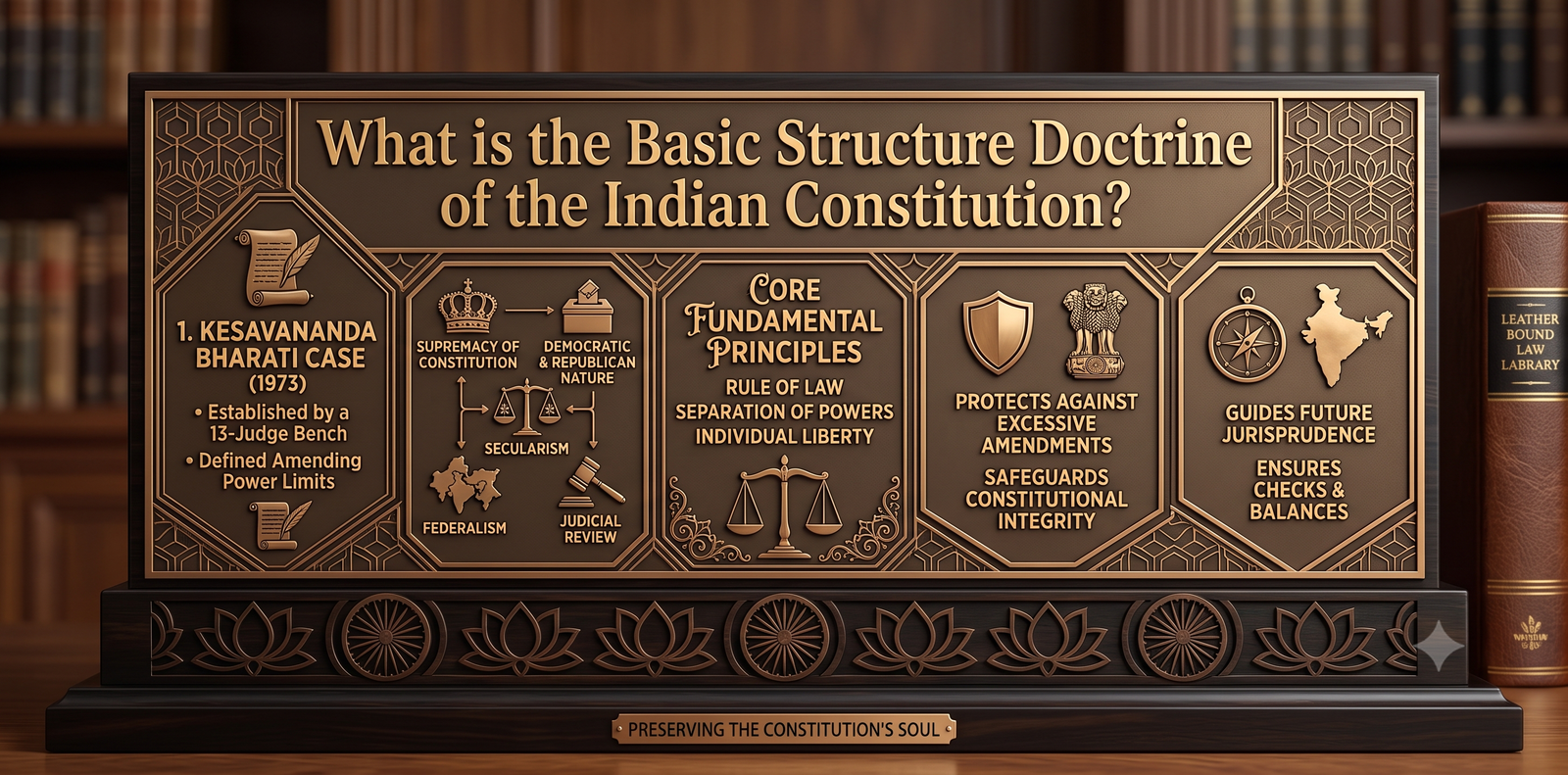
What is the Basic Structure Doctrine of the Indian Constitution?
What is the Basic Structure Doctrine of the Indian Constitution?
If you have ever spent time reading Indian legal history, you have almost certainly run into a phrase that gets tossed around with immense weight: the Basic Structure Doctrine.
It sounds like technical legal jargon, but it addresses a surprisingly human, real-world dilemma: Can a government, just because it holds a massive majority in Parliament, completely rewrite the rules of the country?
If a party wins enough seats, can it vote away your freedom of speech? Can it declare that elections are no longer necessary, or erase the independence of the courts?
According to the Supreme Court of India, the answer is a firm no.
Parliament has the power to update and amend the Constitution to match changing times, but it does not have the power to destroy its core identity. That protective boundary is what we call the Basic Structure Doctrine.
The Core Idea: An Architectural Analogy
To understand how this works in practice, imagine the Indian Constitution as a well-built house.
Over time, family sizes change, technology evolves, and lifestyle needs shift. You might want to repoint the brickwork, repaint the interior walls, rewire the electricity, or even add a balcony. Under Article 368 of the Constitution, Parliament has the toolset to make those updates.
However, you cannot knock out the main load-bearing pillars or demolish the foundation. If you do, the entire structure collapses on itself.
The Basic Structure Doctrine is the legal principle that protects those load-bearing pillars. It separates routine modifications from structural destruction.
How the Doctrine Came to Be: A Decades-Long Tug-of-War
This rule wasn't actually written into the original text of the Constitution in 1950. Instead, it was forged through a high-stakes, decades-long tug-of-war between Parliament and the Judiciary over property rights, individual liberties, and government authority.
The Early Days: Supreme Parliament
In the early post-independence years, the Supreme Court took a hands-off approach. In the 1951 Shankari Prasad case, the court ruled that Parliament’s power to amend the Constitution was practically unlimited. If Parliament wanted to alter Fundamental Rights—such as taking land for public welfare initiatives—it had the power to do so.
The Turnaround: Golaknath (1967)
By the late 1960s, concerns grew about overreach. In the landmark Golaknath ruling, the Supreme Court completely flipped its stance. The judges declared that Fundamental Rights held a sacred position and that Parliament couldn't touch or dilute them at all, even through a constitutional amendment.
This created a deadlock. Parliament felt its hands were tied from passing necessary social legislation, leading to the 24th Constitutional Amendment, where the government passed laws asserting that it had absolute power to amend any part of the document.
The Turning Point: Kesavananda Bharati (1973)
The standoff peaked in 1973 with the legendary Kesavananda Bharati case. A panel of 13 Supreme Court judges sat for 68 days to settle the question once and for all.
By a paper-thin majority of 7 to 6, the court struck a brilliant compromise:
1. They overruled Golaknath, agreeing that Parliament can amend any part of the Constitution, including Fundamental Rights.
2. But they added a crucial condition: Parliament cannot alter or destroy the "Basic Structure" or fundamental identity of the Constitution in the process.
What Actually Counts as "Basic Structure"?
One of the most interesting aspects of this doctrine is that the Supreme Court deliberately refused to write down a permanent, rigid list of what belongs in the "basic structure." The judges knew that if they created a fixed list, clever legislators might find ways around it.
Instead, the court tests laws on a case-by-case basis. Over the years, through various judicial rulings, several core principles have been firmly established as off-limits to parliamentary destruction:
· The Supremacy of the Constitution: The Constitution remains the ultimate authority, not any political party or leader.
· The Rule of Law and Equality: The principle that everyone is equal before the law (Article 14) cannot be erased.
· Secularism: India’s identity as a nation that respects all religions equally cannot be turned into a state religion system.
· Democracy and Free Elections: Parliament cannot vote to abolish elections or extend its own life indefinitely.
· Separation of Powers: The division of duties between lawmakers, the executive, and the courts must be maintained.
· Judicial Review: The right of citizens to approach the courts to challenge unlawful government actions is permanent.
Real-World Examples: The Shield in Action
This doctrine isn't just a theoretical concept taught in law schools; it has actively shaped Indian history during crucial moments.
· Preventing Electoral Abuse (1975): During the Emergency, the government passed the 39th Amendment, which tried to place the Prime Minister’s election beyond the reach of any court challenge. In Indira Nehru Gandhi v. Raj Narain, the Supreme Court struck down that provision, ruling that free elections and judicial review are basic features that no government can bypass.
· Stopping Unlimited Power (1980): In the Minerva Mills case, Parliament attempted to grant itself unlimited power to amend the Constitution without any court intervention. The Supreme Court rejected this, stating famously that a limited amending power is itself a basic feature of our democracy.
· Protecting Judicial Independence (2015): When Parliament passed the 99th Amendment to replace the existing system of appointing judges with a new body (the NJAC), the Supreme Court struck it down, holding that the independence of the judiciary forms a fundamental pillar of the Constitution.
Why It Matters Today
At its core, the Basic Structure Doctrine keeps India's democracy balanced.
It respects the voice of the people by allowing elected representatives to update laws for modern needs. At the same time, it protects citizens from temporary political tides, ensuring that no single government can dismantle the democratic framework that holds the country together.
It stands as a reminder that while politicians hold power for a term, the Constitution belongs to the nation permanently.