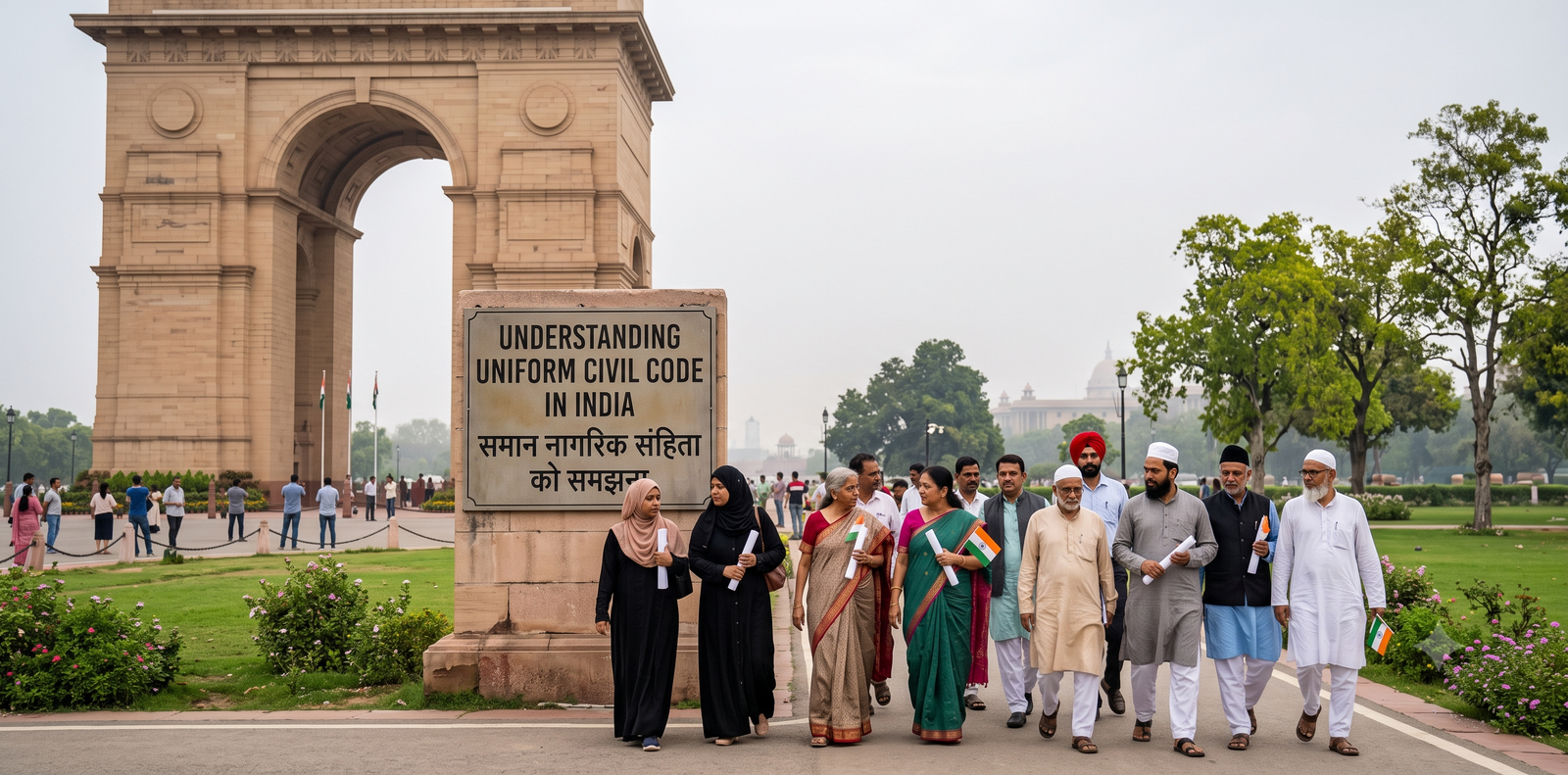
Understanding the Uniform Civil Code in India
Understanding the Uniform Civil Code in India
Few topics in Indian law spark as much passionate debate as the Uniform Civil Code (UCC). Grounded in Article 44 of the Constitution, the idea behind the UCC is simple: to create a single, common set of personal laws governing civil matters—like marriage, divorce, property inheritance, adoption, and maintenance—for every citizen, regardless of their religious identity.
For decades, the UCC remained an aspirational idea tucked away in the Constitution. Today, however, it has moved from law school debate halls straight into active legislation. With recent state-level enactments and legislative updates, the UCC has entered a whole new chapter in India's legal journey.
Here is a clear look at what the Uniform Civil Code actually means, how the courts have shaped it, how states are putting it into practice, and where the debate stands today.
The Constitutional Balance: Article 44 vs. Personal Laws
To understand the legal mechanics of the UCC, we have to look back at the original blueprint drawn up by the framers of the Constitution.
Under Article 44 (which falls under Part IV, the Directive Principles of State Policy), the Constitution reads:
"The State shall endeavour to secure for the citizens a Uniform Civil Code throughout the territory of India."
During the Constituent Assembly debates, leaders like Dr. B.R. Ambedkar strongly advocated for a common civil code. They saw it as a vital step toward removing gender-discriminatory practices buried within various faith-based personal laws. However, given the immense social sensitivities following Partition, the Assembly chose to place the UCC in Part IV. This meant Article 44 set a long-term goal for the nation, but it wasn't directly enforceable in a court of law like a Fundamental Right.
As a result, India kept its diverse ecosystem of personal laws—such as the Hindu Marriage Act, the Muslim Personal Law (Shariat) Application Act, the Indian Christian Marriage Act, and the Parsi Marriage and Divorce Act.
This setup created a ongoing constitutional balancing act between two key principles:
Article 44: Aiming for equal legal rights and gender justice across civil life.
Articles 25 to 28: Protecting the fundamental right to practice, profess, and propagate your religion.
Landmark Court Cases: How the Judiciary Pushed for Change
Over the last forty years, the Supreme Court of India has repeatedly stepped in to highlight the need for a common civil code—especially when dealing with cases involving women's rights and gender inequality.
Shah Bano Begum (1985)
In this benchmark case, the Supreme Court ruled that a divorced Muslim woman had the right to claim financial support (maintenance) under the Code of Criminal Procedure. The Court noted that a common civil code would help strengthen national unity by removing conflicting legal standards across communities.
Sarla Mudgal (1995)
The Court addressed a trend where non-Muslim men were converting to Islam solely to marry a second time without legally divorcing their first wife. The Supreme Court declared these second marriages illegal and bigamous, pointing out that a uniform code would close such legal loopholes.
Shayara Bano (2017)
In a historic ruling, the Supreme Court struck down the practice of Talaq-e-Biddat (instant triple talaq), declaring it unconstitutional and arbitrary. This judgment firmly established that personal or customary practices cannot take precedence over basic constitutional equality.
What Does a Uniform Civil Code Actually Regulate?
A common myth is that a Uniform Civil Code will alter how people pray, perform religious rituals, or conduct traditional ceremonies. Legally speaking, a UCC does not touch religious worship or spiritual beliefs. Instead, it focuses strictly on the secular, civil aspects of family life:
Marriage and Divorce: Establishing a uniform legal age for marriage, banning polygamy, making marriage registration mandatory, and creating equal grounds for divorce for all genders.
Property and Inheritance: Guaranteeing equal inheritance rights for daughters, sons, and surviving spouses, replacing old customary rules that favor male heirs.
Maintenance and Alimony: Ensuring standard financial protections for spouses and dependent children after a marriage ends.
Adoption and Guardianship: Granting universal, secular adoption rights so that any individual can legally adopt a child, regardless of their faith.
Live-in Relationships: Introducing basic registration processes and safety nets for partners in informal unions.
State-Level Implementation & Recent Updates
Because personal law falls under the Concurrent List (Item 5 of Schedule VII of the Constitution), both Parliament and State Legislatures have the authority to pass civil laws. In recent times, individual states have taken the lead in crafting local UCC frameworks.
The Uttarakhand Benchmark
Uttarakhand became the first state in post-independence India to pass a state-level code—the Uniform Civil Code of Uttarakhand Act. The law sets uniform rules for marriage, divorce, succession, and live-in relationships, while explicitly protecting the customary rights of Scheduled Tribes under Article 342.
To handle practical ground realities, the state later introduced key legislative refinements:
Protections Against Fraud: Concealing your identity to marry someone is now recognized as a valid ground for annulling a marriage.
Streamlined Registration: To prevent bureaucratic delays, marriage and relationship registrations not cleared within set timeframes are automatically escalated to higher officers.
Gender-Neutral Language: Outdated terms like "widow" have been replaced with gender-neutral words like "spouse" to ensure equal standing in statutory documents.
Updating Legal References: Statutes have been updated to align directly with India's modern criminal codes—the Bharatiya Nyaya Sanhita (BNS) and Bharatiya Nagarik Suraksha Sanhita (BNSS).
Following this model, states like Gujarat, Assam, and Madhya Pradesh have also moved forward with their own drafting processes, making state-level action the primary testing ground for broader uniformity.
The Core Debate: Uniformity vs. Diversity
The conversation around the Uniform Civil Code brings out strong, thoughtful arguments from all sides.
Arguments Supporting a Common Code
Gender Justice: Traditional personal laws across almost all faiths historically favored men in matters of property and divorce. A uniform code puts men and women on equal legal footing.
Legal Clarity: Replacing a patchwork of overlapping faith-based statutes with a single, clear code simplifies the legal system and reduces court confusion.
National Cohesion: A shared set of civil rights fosters a stronger sense of common citizenship.
Concerns and Critiques
Religious Freedom: Critics worry that enforcing a single civil standard might infringe upon minority cultural rights and religious practices protected under Articles 25 and 29.
Protecting Indigenous Customs: India's diverse tribal communities follow unique customary traditions that don't easily fit into a standardized civil framework. Most state-level UCCs have had to include specific exemptions for tribal groups.
Pluralism over Uniformity: Many legal scholars argue that true equality doesn't always require absolute uniformity—suggesting that reforming individual personal laws from within might be a smoother, more inclusive approach.
The Road Ahead
The journey toward a Uniform Civil Code is no longer just an academic topic—it is a live legislative transition being shaped by state laws, court rulings, and public discourse.
The real test of any civil code lies in its ability to uphold two foundational values at once: securing equal rights and gender justice for every citizen, while protecting India's rich cultural diversity. As state codes roll out and adapt, they offer a real-world look at how legal equality and individual liberty can work hand in hand.
Summary Takeaway: The Uniform Civil Code (Article 44) replaces faith-based personal laws with a single civil code for marriage, divorce, inheritance, and adoption. Backed by key rulings like Shah Bano and Shayara Bano, the UCC is now becoming a practical reality through state legislation focused on gender equality, legal clarity, and administrative efficiency.