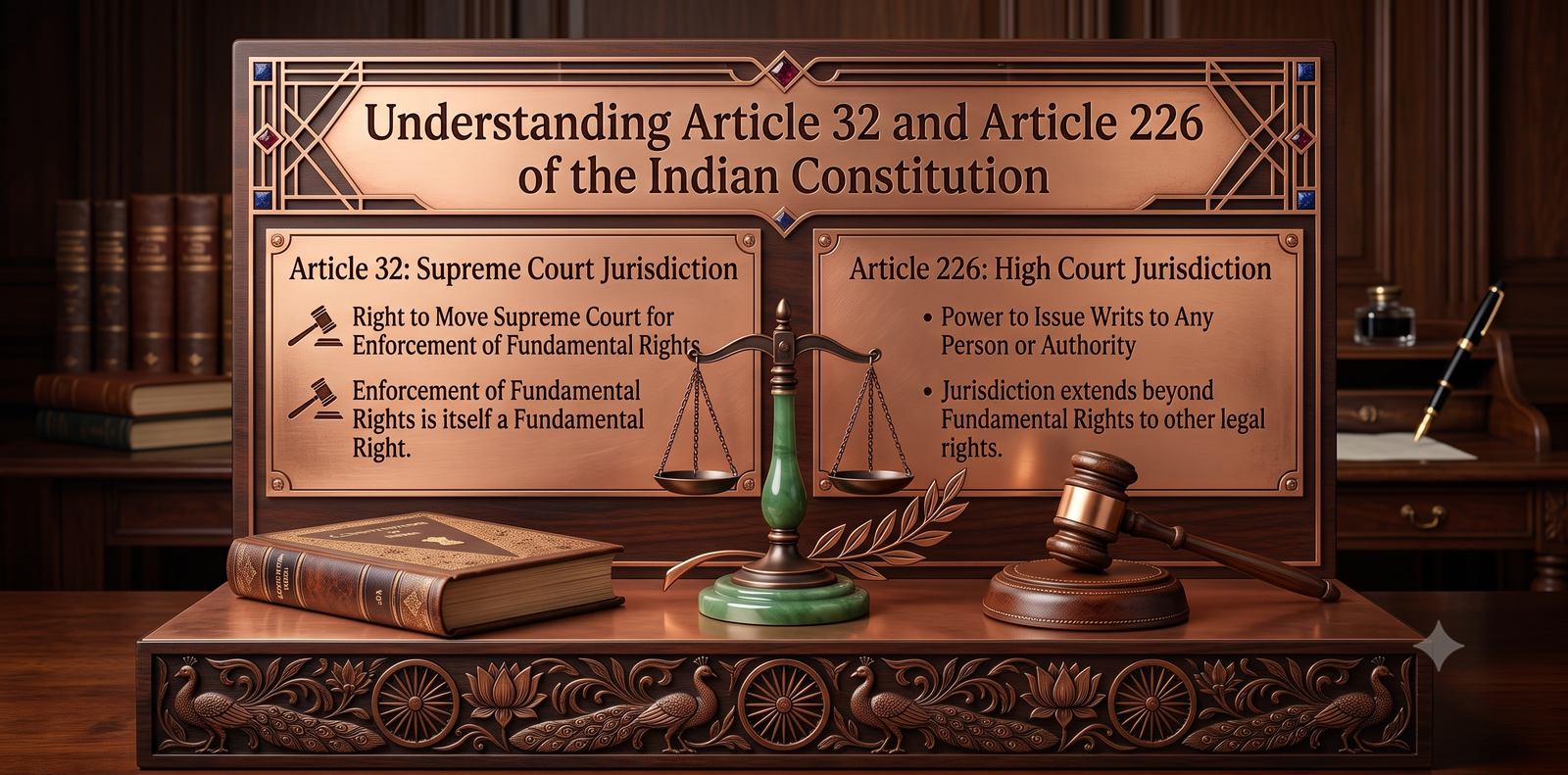
Understanding Article 32 and Article 226 of the Indian Constitution
Understanding Article 32 and Article 226 of the Indian Constitution
Imagine having a full list of guaranteed rights—freedom to speak your mind, equality before the law, and protection of your personal liberty—without any real way to enforce them if someone steps on those rights. They would end up being little more than inspiring promises written on parchment.
The framers of the Indian Constitution knew this trap all too well. They understood that rights are only as strong as the remedies available to protect them. To make sure fundamental rights didn't turn into empty promises, they placed two powerful enforcement engines right inside the Constitution: Article 32 and Article 226.
Dr. B.R. Ambedkar famously described Article 32 as the very "heart and soul" of the entire document. Working alongside Article 226, these provisions form the primary shield that defends everyday citizens against state overreach and illegal government action.
What Are Constitutional Remedies and Writs?
Before comparing the two provisions, it helps to understand what a writ actually is.
In simple terms, a writ is an official court order directing a public authority, official, or lower court to do something specific—or to stop doing something unlawful. In India's legal system, writs act as rapid-response tools for citizens whose rights are being violated.
Indian Constitutional Law recognizes five classic types of writs:
Habeas Corpus ("To have the body of"): Used when someone is unlawfully detained. The court orders the authorities to bring the person forward and show a valid legal reason for keeping them behind bars.
Mandamus ("We command"): Issued to force a public official, agency, or lower court to carry out an official duty they are legally required to do but are refusing to perform.
Certiorari ("To be certified"): Sent to a lower court or tribunal to cancel an order that was passed without proper legal authority or in violation of natural justice.
Prohibition: A preventive order sent to a lower court to halt ongoing proceedings because the court lacks the jurisdiction to hear the case in the first place.
Quo Warranto ("By what authority"): Used to challenge someone who has unlawfully occupied or claimed a public office they aren't legally entitled to hold.
Article 32: The Supreme Court's Sacred Guarantee
Article 32 lives inside Part III of the Constitution—the section dedicated to Fundamental Rights. This location is a big deal. It means that the right to approach the Supreme Court when your fundamental rights are violated is itself a Fundamental Right.
Because of this setup, an aggrieved citizen doesn't have to ask for permission to be heard. You have a direct, constitutional right to knock on the doors of the Apex Court.
However, Article 32 has a very specific scope. You can only use it to enforce Fundamental Rights. You cannot use Article 32 for general legal disputes, contract arguments, or ordinary property claims.
Over the years, the court also opened up access through Public Interest Litigation (PIL). Originally, only the person directly harmed could file a case. Today, concerned citizens or advocacy groups can approach the court under Article 32 on behalf of disadvantaged communities who can't fight for themselves.
Crucially, the Supreme Court has declared that Article 32 is part of the Basic Structure of the Constitution. Parliament cannot vote it away or strip the court of this power through amendments.
Article 226: The High Court's Flexible Powerhouse
While Article 32 focuses on the Supreme Court, Article 226 gives writ powers to the High Courts in every state.
Interestingly, Article 226 actually gives High Courts a broader scope of power than the Supreme Court has under Article 32. Article 226 allows High Courts to issue writs not just for Fundamental Rights, but also "for any other purpose."
That extra phrase—"for any other purpose"—means you can turn to a High Court under Article 226 to enforce ordinary legal rights, statutory rights, or administrative fairness, not just constitutional freedoms.
The tradeoff is that Article 226 is a discretionary power rather than an automatic right. A High Court can choose to decline a writ petition if there is already an equally effective, standard legal remedy available to you elsewhere (like an administrative appeal).
Territorially, a High Court's writ authority covers its home state, or anywhere the underlying cause of the dispute took place.
How Article 32 and Article 226 Differ in Practice
Understanding how these two tools stack up against each other comes down to a few key differences in how they function.
First, where you go dictates the source of the power. Article 32 takes you straight to the Supreme Court of India in New Delhi, whereas Article 226 takes you to the relevant High Court within a state.
Second, the scope of protection varies significantly. Article 32 is laser-focused on defending Fundamental Rights listed in Part III. Article 226 covers those same Fundamental Rights, but stretches further to protect ordinary legal rights as well.
Third, the nature of the relief is different. Approaching the Supreme Court under Article 32 is a guaranteed fundamental right that the court cannot easily turn away if a core right is violated. Approaching a High Court under Article 226 is a constitutional power that the judges exercise at their reasonable discretion.
Finally, there is a difference in geographic reach. A Supreme Court ruling under Article 32 applies across the entire nation. A High Court writ under Article 226 applies within that specific state's border or wherever the cause of action originated.
Which Court Should You Approach First?
Since both courts hold writ jurisdiction, people often wonder if they should skip the High Court and head straight to the Supreme Court under Article 32.
Technically, you have the right to do that for fundamental rights issues. However, the Supreme Court has set up a clear rule of judicial discipline: you are generally expected to approach the High Court under Article 226 first.
High Courts are geographically closer to litigants and usually better equipped to handle initial factual reviews. If you decide to bypass your local High Court and go straight to the Supreme Court in New Delhi, you need to present a strong reason explaining why the High Court couldn't handle the situation.
Real Cases That Shaped Writ Power
The practical power of these articles has been built brick-by-brick through landmark court cases over the decades.
In early cases like A.K. Gopalan v. State of Madras (1950), the court began establishing how writs like Habeas Corpus would operate to protect personal freedom against arbitrary arrest.
Decades later, in Bandhua Mukti Morcha v. Union of India (1984), the Supreme Court used Article 32 to revolutionize Public Interest Litigation, deciding that strict procedural rules shouldn't prevent poor or exploited workers from getting constitutional relief.
Then came L. Chandra Kumar v. Union of India (1997), a major ruling where a 7-judge bench declared that judicial review under both Article 32 and Article 226 forms part of the unchangeable Basic Structure of the Constitution. This meant that specialized administrative tribunals could never bypass or take away the High Court's writ powers.
Why These Remedies Matter in Everyday Life ?
At the end of the day, Articles 32 and 226 keep the rule of law alive in modern India.
They give everyday people a direct channel to challenge government abuse, stop illegal arrests, force lazy departments to do their jobs, and strike down unlawful orders. Without these remedies, constitutional rights would just be poetic ideas. With them, they remain real, active protections for every citizen.
Quick Summary: Article 32 is a guaranteed fundamental right designed strictly to defend Part III rights at the Supreme Court level. Article 226 gives High Courts a broader, discretionary power to defend both fundamental rights and regular legal rights. Together, they form the cornerstone of judicial protection in India.